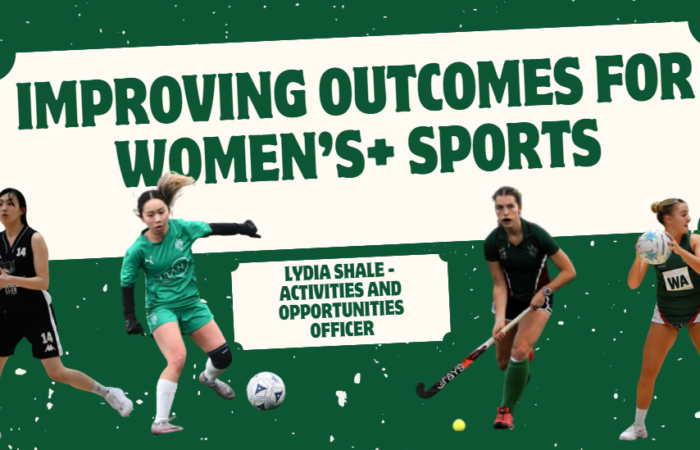
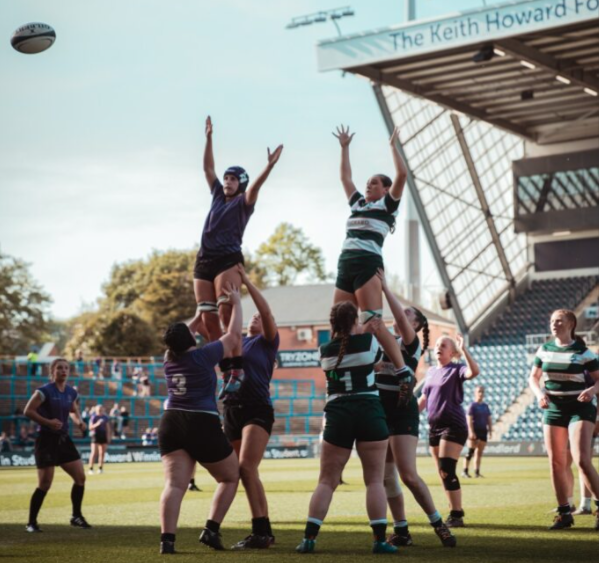

When I started the role of Activities and Opportunities Officer, I already knew that womens+ sport at Leeds deserved better.
Being involved with women’s football myself, I’d seen the imbalance first hand. Women’s teams were framed around participation, while men’s teams were framed around performance.
That difference shaped everything- from pitch allocations to training times to the way clubs were supported. As participation in women’s+ sport continued to grow, the cracks became even more obvious.
What I didn’t expect was just how strongly this would resonate across campus. Conversations with friends in other sports revealed the same frustrations, the same barriers, and the same desire for change.
That’s when the Women’s+ Sports Participation Project began to take shape.
How Did it Begin?
I started by running focus groups with ten societies. These were honest, energised, and sometimes emotional discussions about what it feels to constantly fight for space, time, and recognition.
Students spoke about juggling increased numbers with limited resources, about feeling overlooked, and about wanting a sporting experience that matched their ambition. Their insight made one thing clear: this wasn’t a small issue. It was structural.
My first instinct was to push for a full‑time Women’s+ Sports Coordinator. But after exploring funding options, it became obvious that one person couldn’t carry the weight of such a wide‑ranging project. Instead, the most powerful thing we could do was amplify student voices directly to the people who could make change happen.
This led to one of the proudest moments of my year: bringing those ten societies together to present their experiences directly to key stakeholders.
Each society had 7–10 minutes to share their reality. Stakeholders listened, asked questions, and—most importantly, understood. Students left feeling heard; staff left with a clearer picture of the work ahead. It shifted the tone from “this is a complaint” to “this is a shared responsibility.”
And from there, things started to move.
Impact and Changes
Across clubs, we were able to make a number of quick, practical changes that immediately improved the experience for women’s+ teams.
These ranged from adjustments to training schedules and access to facilities to clearer principles around how space is allocated. Even in areas where the challenges were more complex, we still saw movement and constructive conversations that set the groundwork for longer‑term improvements.
While each change varied in scale, together they marked a meaningful shift toward a fairer and more equitable sporting offer.
One of the biggest breakthroughs was securing funding for five Women’s+ Sports Activators.
Each Activator is working 150 hours this year, directly supporting societies and helping lead on trans inclusion in sport. We had 47 applicants in just two weeks, a clear sign of how many students want to be part of this movement.
What’s been even more impressive is the quality of the work they’ve delivered: they’ve built trust with clubs, driven conversations that might never have happened otherwise, and brought an energy and commitment that has lifted the entire project.
Their impact has already been felt across campus, and they’ve played a huge role in pushing this work further than one officer ever could. The activators give the project the capacity it needs to grow sustainably, long after this year ends.
Why Does it Matter?
The mixed‑gender sports tournaments became one of the most powerful parts of the project, not just because they were fun and well attended, but because they offered something that has become increasingly rare in the national sporting landscape: a genuinely inclusive space.
With over a hundred students expressing interest, the events brought together people of all genders and abilities, creating an atmosphere that felt welcoming, celebratory, and free from the pressures or exclusions that too often shape traditional sport.
This felt especially important in the wake of the recent Supreme Court ruling, which has led many national governing bodies to introduce policies that restrict or remove trans people’s ability to participate in sport. The feedback we received reflected that, with students describing how rare it is to find sporting spaces where they feel fully included.
These tournaments showed what sport at Leeds can be when equity is prioritised: open, joyful, and accessible to everyone who wants to take part. One student who attended said:
“As a trans person I often feel disenfranchised from sport… More events like this would really help my health and wellbeing.”
That comment alone captures why this project matters.
It’s not just about fairness- it’s about belonging, confidence, and wellbeing.
This year has shown just how much change is possible when students speak up and when the institution truly listens.
We’ve pushed conversations into rooms they’ve never reached before, advocated at the highest levels of the university, and turned long‑standing frustrations into real, visible progress.
Sport at Leeds is already a better, fairer, more supportive place for women’s+ students because of the work we’ve done together. But we can’t stop here. We must keep this momentum going until sport is truly accessible for all.